
Preliminary energy costs of local AI on a real workload
Preliminary electricity costs for a local AI run, compared with listed cloud API prices for the same number of tokens.
Preliminary energy-consumption figures have been collected from real-world local AI workloads, using measurements and system logs. The figures are still estimates, but they give a reasonably accurate picture of the overall economics.
The measurements were made on a power-efficient laptop with a modern GPU, costing around $4,000–4,500 (€4,000–4,500). On less energy-efficient hardware, electricity costs will likely be higher and may approach the API prices of the cheapest Chinese models. Those models are often available for free, or with discounts of up to 90%. In those cases, cloud AI can be cheaper than the electricity alone required for local inference.
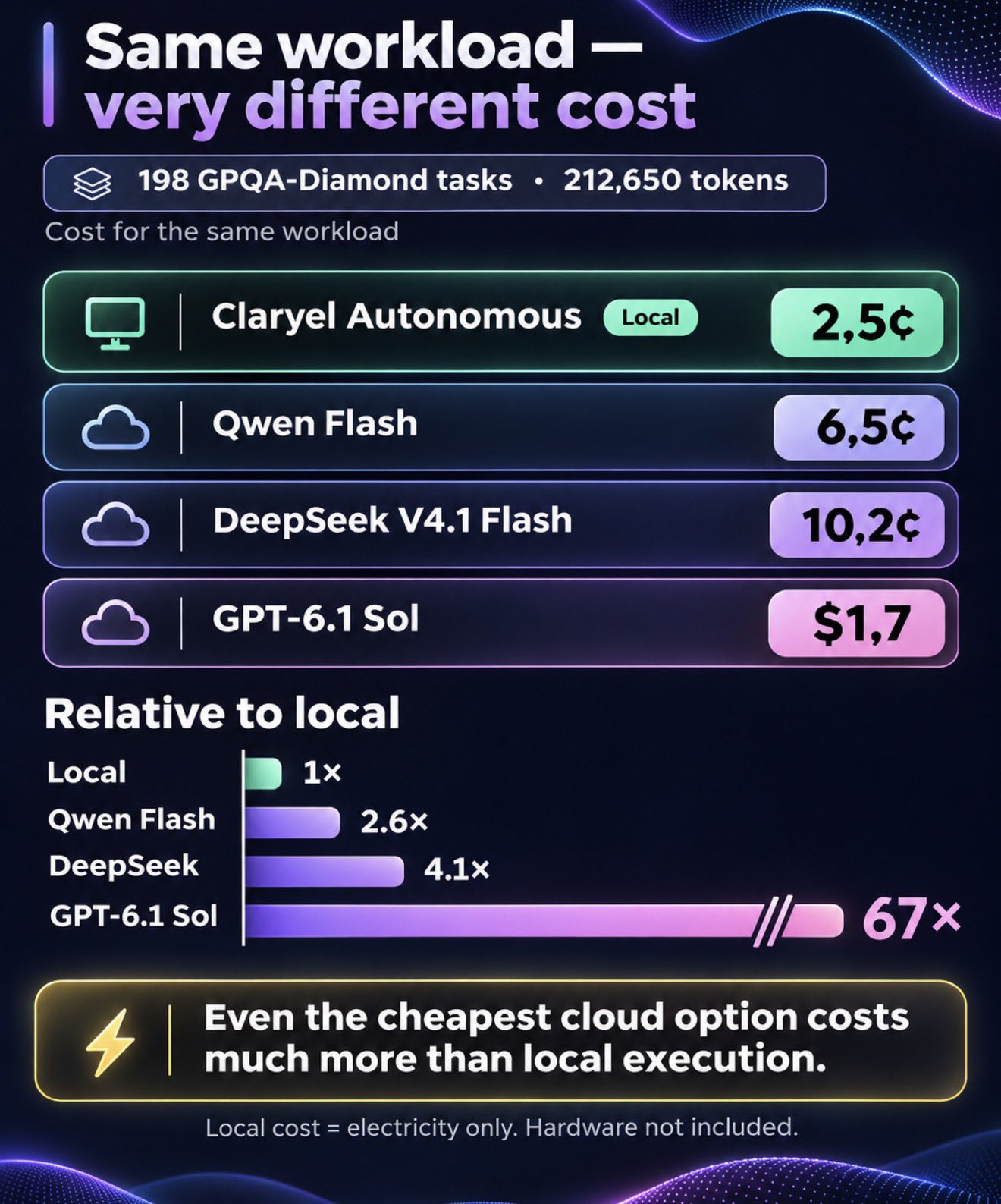
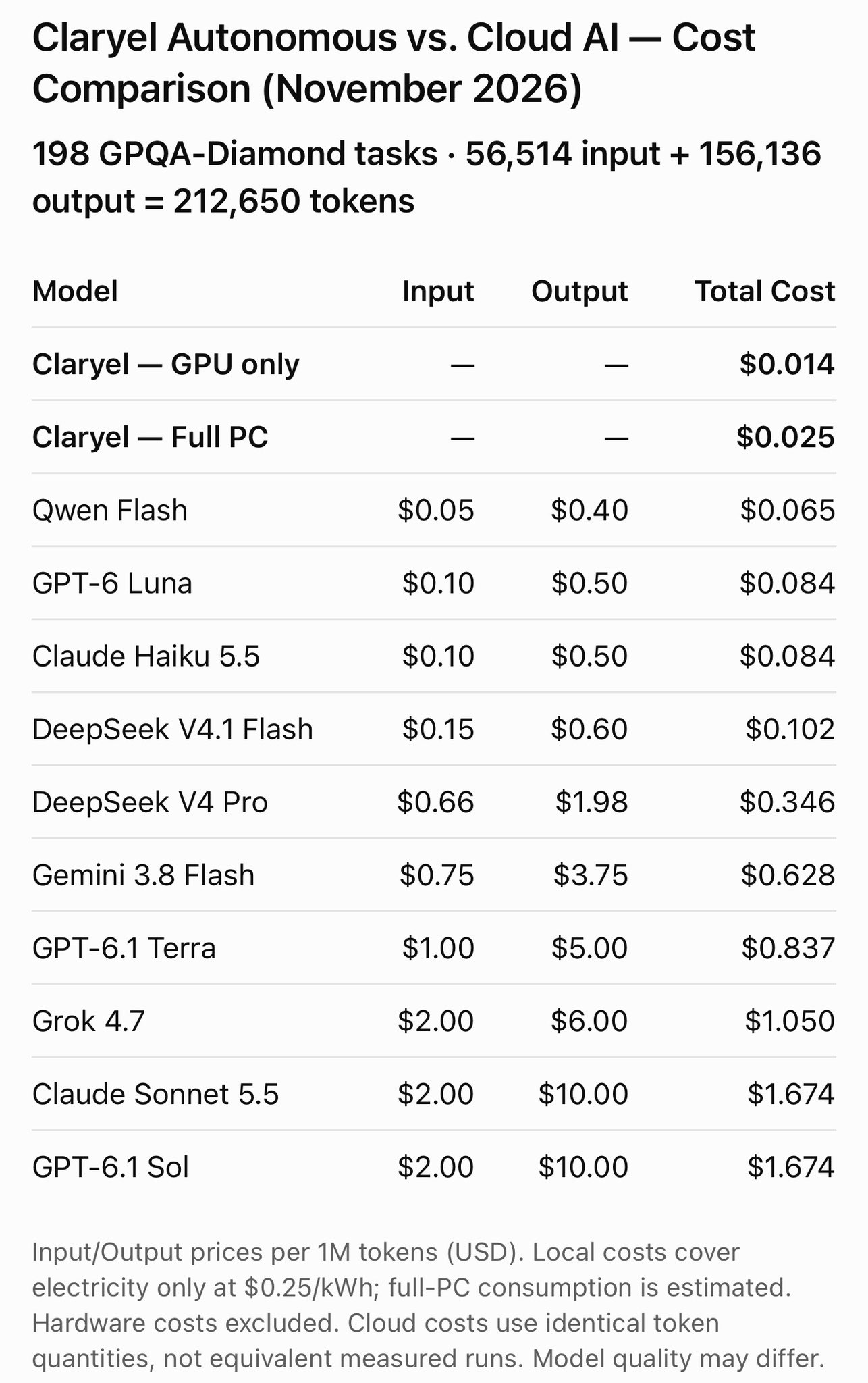
The charts published with the post compare one workload — 198 GPQA-Diamond tasks, 56,514 input tokens and 156,136 output tokens, 212,650 tokens in total — at electricity of $0.25/kWh. Local costs in the table are $0.014 for the GPU only and $0.025 for the estimated full PC. Listed cloud totals for the same token count range from $0.065 (Qwen Flash) to $1.674 (Claude Sonnet 5.5 and GPT-6.1 Sol). A note on the table states that hardware is excluded, that cloud costs use identical token quantities rather than equivalent measured runs, and that model quality may differ.
These are preliminary results. Further measurements are planned, and findings are to be published on GitHub.