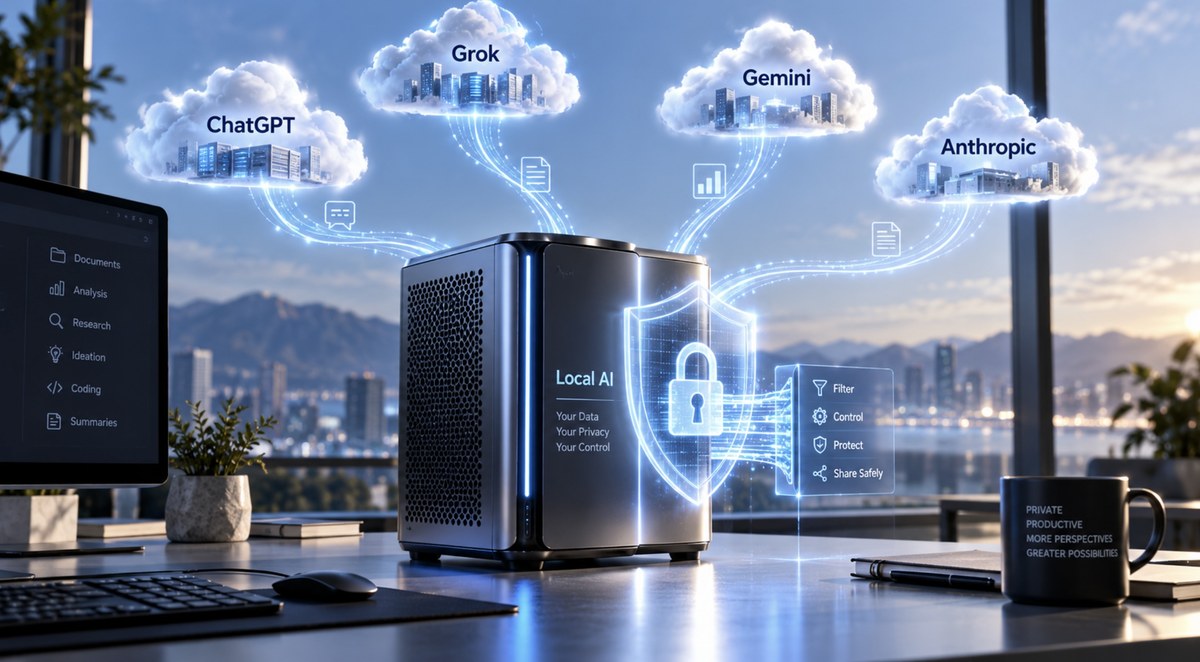
Illustration of the concept. The names on the clouds are examples of compatible cloud models; CLARYEL is independent of their providers.
Why your own artificial intelligence should become the foundation of your digital independence, and cloud models an extension of your capabilities.
Artificial intelligence is rapidly changing how we work, run businesses, process documents, search for information and make decisions.
Until recently, access to intelligent systems of this level came mainly through large technology companies. Today there are two complete approaches: cloud AI services and local systems that can be installed on your own computer.
So a natural question arises: which one should you choose? Use the leading cloud models, or buy your own AI computer that stays at home or in the office?
Our answer: you do not have to choose between them. The right architecture for the future is your own local intelligence that, when needed, safely uses the capabilities of several external intelligent systems.
At CLARYEL we call this approach combined, or multi-intelligence, artificial intelligence.
In this architecture the local system remains the centre for control, document storage, work with personal data and everyday tasks. Cloud models are connected as additional intelligent resources when their capabilities are really needed.
This lets you combine digital independence with access to the most advanced achievements of the global AI industry.
Why Local AI?
1. Why artificial intelligence is no longer just a chatbot
Many people first met artificial intelligence through an ordinary chat: ask a question, get an answer, ask it to write a letter or translate a text.
But the real capabilities of modern technology are much broader. Artificial intelligence can become a permanent digital assistant that knows the structure of your company, works with the documents it is allowed to use, helps employees, analyses information and carries out practical tasks.
For example, it can:
Find the contracts, invoices, letters and other documents you need.
Analyse financial indicators and business processes.
Compare information from several sources.
Prepare commercial offers and business correspondence.
Help with accounting documents and data checks.
Process technical documentation.
Translate between different languages.
Help with programming and the automation of workflows.
Analyse supplier offers.
Detect inconsistencies, duplicate records and suspicious transactions.
Work with the company’s internal knowledge base.
Help management prepare decisions based on the available information.
Serve employees through a single text or voice interface.
Supervise permitted automated operations.
The wider artificial intelligence is used, the more information it receives about your activity. The question is no longer only how smart the model is. A more important question arises:
Who controls the information your artificial intelligence works with?
Who owns the documents? Where is the work history stored? Who sets the access rules? Who decides which information may be sent to external services? In our view, a serious intelligent infrastructure has to start with these questions.
2. Local artificial intelligence: the foundation of digital independence
Local artificial intelligence is a system in which the AI models, their working environment and the necessary data are hosted on hardware under your control: an ordinary personal computer, a specialised workstation or a more powerful machine. The principle stays the same.
Your documents are processed on your hardware. Your internal knowledge bases sit in your infrastructure. You decide who gets access and under which conditions. For a business this is not just a technical detail; it is a fundamental principle of how information is handled.
Confidentiality of your documents
Every company keeps information that is not meant for free circulation: contracts, commercial terms, internal calculations, financial documents, customer data, business correspondence, development plans, technical solutions and other valuable information. A local system lets you process such documents without necessarily passing their content to external AI providers. With a correctly configured infrastructure, processing can even take place without an internet connection. The company decides which data the intelligent system can access, where it is stored, how long it is kept and when it is deleted.
Protection of employees’ personal information
Employee data needs particularly careful handling. Salaries, employment contracts, personal contacts, HR documents and other personal information should not be passed to outside services without control. A local intelligent system can help HR, management and accounting by processing such information inside a controlled infrastructure. Access to data must follow the rights of each employee: artificial intelligence must not become a tool that gives any user access to all company information.
Protection of customer information
Customers entrust a company not only with money but also with their information: depending on the business, contact details, order history, payment information, projects, business documents and records of their dealings with the company. Local artificial intelligence makes it possible to build a process in which this data is handled mainly inside the company. This strengthens trust and gives the company more room to control the processing itself.
Protecting trade secrets
For many businesses the most valuable asset is not the computers. It is accumulated knowledge: production processes, internal instructions, unique solutions, pricing strategies, cost calculations, customer relationships, research and development. A local system lets you use artificial intelligence on this knowledge without making the sending of information to external services a mandatory step of every operation.
Control over the history and memory of your AI
With use, an intelligent system can build up useful context: your preferences, the specifics of the company, the structure of documents, working rules and the results of earlier tasks. This information gradually becomes an important part of your digital infrastructure. We consider it essential that the company can keep this context in-house, manage retention periods, make backups and move information between compatible software solutions. Your own intelligence should work for you, not make you dependent on a single external provider.
Predictable costs
Another important advantage of your own intelligent system is a different cost model. With cloud interfaces you usually work within the terms of the chosen plan. When external models are used programmatically through an API, the cost can depend on the number of tokens processed, the chosen model, the context size, additional tools and other parameters. Once a company starts automating actively, the number of requests can grow very quickly.
Your own local intelligence works differently. You buy the computing hardware and use the models installed on it within the available hardware resources. A local model sends no bill from a cloud provider for every token processed. You can analyse documents again, experiment with requests, run checks, build internal automations and use the model as much as the hardware allows.
Of course, this does not mean there are no costs at all. Your own system uses electricity, needs maintenance, and its performance and available memory are limited by the hardware. But you gain the main advantage: predictability and direct control over your own computing infrastructure. Instead of depending only on how much remote capacity you consume, the company gets its own computing power for many tasks, which is especially interesting for regularly repeated operations.
Working independently of the cloud provider
A local architecture gives another important possibility: carrying out core tasks even when an external intelligent service is unavailable. With the right setup, local models can work without the internet. This matters for organisations that need stable work with documents, internal search and knowledge every day.
Your own system also lets you choose compatible models, change them, evaluate new versions and build automations around your own infrastructure. The company does not have to tie all its internal work to one service forever. Several local models can be used for different tasks: one for everyday conversation, another for document analysis, a third for programming, a fourth for specialised operations. The result is not just an installed program but your own intelligent infrastructure.
The advantages of a local system grow over time
Buying your own intelligent computer is not necessarily a one-off decision with fixed capabilities. Models and software keep evolving. You can install new compatible models, improve search tools, add voice interfaces, connect company knowledge bases and refine workflows.
Where the hardware design allows it, you can add memory, install more storage, upgrade the graphics subsystem or move to a more powerful system. The initial investment can be the first stage of development: starting from a small local configuration, the company gradually builds its own intelligent infrastructure according to real needs and the available budget.
For us this matters more than trying to persuade every customer to buy the most expensive hardware straight away. Start with what you really need today. Grow the system as your tasks grow.
Why cloud artificial intelligence is also necessary
After all these advantages of local systems, another question arises: if your own intelligence offers so much, why use cloud models at all? The answer is simple: today cloud systems are an extremely powerful and useful tool, and we are convinced it would be unwise to give up their capabilities.
Access to frontier research
Behind the leading cloud models stand large research teams, significant computing resources and huge investments. Their developers build intelligent systems that keep pushing the boundaries of available technology. A cloud service user benefits from this work without having to create and train such large models themselves.
High intelligent performance
Advanced cloud models can solve complex tasks that need multi-step analysis, programming, unconventional solutions and the processing of large volumes of information. They are especially useful when a task goes beyond the capabilities of the installed local model. Large providers offer access to computing infrastructure that would make no economic sense for a small company to build on its own.
Low entry barrier
To start with cloud AI you usually do not need specialised hardware: creating an account and choosing a suitable way to use it is enough. Some providers offer free plans for limited use and relatively inexpensive starter subscriptions. With a small number of requests, paid interfaces and programmatic connections can be very economical. Just remember that a free chat and free programmatic access are not the same thing: availability, limits and terms of use depend on the specific service, the region and the chosen plan.
Fast access to new capabilities
Cloud platforms regularly update their models and offer new tools: richer processing of text, images, program code, documents and other kinds of information. Sometimes choosing another model or activating a new tool is enough to get capabilities that used to require complex technical setup.
Convenient user interfaces
Large providers invest heavily not only in model quality but also in ease of use. Voice conversation, file upload, document analysis, building programs, project work and other features come together in interfaces designed for a wide audience. That is why cloud intelligence is often a convenient tool for quickly solving everyday tasks.
Economical extension of capabilities
If the local system cannot handle a specific complex task, a cloud model can carry out additional analysis. There is no need to buy much more powerful hardware for a task that comes up a few times a month: you can use remote computing resources exactly when you need them. This is one of the main economic ideas of the hybrid approach.
Access to several schools of thought
Different developers use their own training methods, architectures, evaluation systems and approaches to building models. As a result, different models may approach the same task differently: one offers a good structure for the answer, another notices an extra circumstance, a third finds an alternative solution. For complex tasks this creates valuable additional possibilities.
The key point: the advantages of cloud intelligence are so significant that a sensible local system should be able to use them.
How They Work Together
Why we propose combining rather than choosing
Local and cloud architectures offer different but complementary advantages. The local system provides your own computing base, control of information, the ability to work autonomously and predictable costs for internal processing. Cloud models give access to the advanced capabilities of the world’s largest developers without having to buy comparable computing power yourself.
So why not combine them into one system? This is the approach we consider most promising. Local intelligence becomes the user’s main assistant; external models become additional tools it can call on when needed. The user talks primarily to their own local system, without constantly switching between services, copying conversations from one window to another and deciding alone which documents may be uploaded where. A well-built architecture organises the work centrally.
You
CLARYEL Local AI
Your data policy
Handled locally
Permitted external request (filtered)
Results combined locally
Answer
Conceptual diagram, simplified. The actual flow depends on the configuration and the rules you set.
How local intelligence can reach the cloud more safely
Imagine you ask your intelligent assistant a question. The local system receives the request and determines which data is needed to carry it out. If the task can be solved with its own resources, it is done locally. If it is useful to involve an external model, the system applies the data transfer rules set by the user.
Such rules can include classifying documents, excluding certain types of information, removing personal data, replacing names and identifiers with placeholders, reducing the context sent and asking the user for additional approval.
One entry point instead of many separate services
Normally a user opens one service, asks a question, then moves to another, repeats the request and compares the answers. This works, but it becomes inconvenient as the number of tasks grows.
We propose a different approach: the user turns to their own local intelligence. The system knows the tools available to it and can choose a suitable way to carry out the task according to the rules set. For example: a local model for everyday internal tasks; a powerful external model, after the necessary processing of the request, for complex analysis; a second model for an additional check; and finally the local system combines the answers and keeps what is needed in your own knowledge base.
The user thus gets the advantages of several models through one managed working environment. This is especially valuable for companies where artificial intelligence is gradually taking part in more and more workflows.
Six scenarios
Each scenario shows the same pattern: what is done locally, what may go to the cloud if needed, and the result.
Employment contract
Task
Get an independent analysis of the wording of an employment contract containing the employee’s name, home address, ID data, salary and specific terms.
Locally
The local system analyses the document itself first and keeps the original.
Cloud, if needed
A request anonymised as far as possible: “Analyse a standard employment contract clause for clarity, completeness and possible legal issues, and list what must be checked under Italian labour law.” No name, address or identifying data is needed.
Result
The local system matches the recommendations with the original document, which stays in your infrastructure.
Client documents
Task
Answer a question about a client’s file: orders, payments, correspondence.
Locally
Search, summary and answer are done on the local knowledge base, within the user’s access rights.
Cloud, if needed
Usually not needed. If a general question arises (for example on a document type), only that general question is sent, without client data.
Result
The client’s information is handled inside the company.
Commercial offers
Task
Compare the terms of several suppliers.
Locally
The local system collects data from the documents and extracts characteristics, prices and terms.
Cloud, if needed
Ideas for the comparative analysis, without managers’ personal data, internal document numbers or commercial details not needed for that request.
Result
A structured comparison prepared locally, enriched by external suggestions.
Technical problem
Task
An employee describes an equipment fault.
Locally
Local intelligence has the internal technical documentation and service history, and extracts only the equipment characteristics, symptoms and technical context.
Cloud, if needed
An external model suggests diagnostic options.
Result
The local system matches the suggestions with your actual configuration and internal instructions.
Financial data
Task
Explain variances in internal financial figures.
Locally
Calculations, comparisons and explanations are done locally on your accounting documents.
Cloud, if needed
Only if useful: a general methodological question, without amounts, names or company identifiers. The most sensitive data can be set never to leave the local system.
Result
Figures stay in-house; you receive an explanation you can verify against the source documents.
Decision with several models
Task
Prepare a significant investment decision.
Locally
The local system keeps the source data and prepares filtered summaries.
Cloud, if needed
One model analyses the technical part, a second evaluates the economic assumptions, a third looks for alternative scenarios and weak points.
Result
The local system combines the results and helps prepare the questions to verify before deciding.
What is available now, what is configured, what is in development
We separate clearly what you can use today from what is set up for you and what is a direction of development.
Available nowYour documents, internal knowledge base and AI processing stay on the CLARYEL computer in your office.
Available nowExternal models only through a filter: personal data and trade secrets are removed while keeping the meaning of the request.
ConfigurableShowing you the filtered request and sending it only after your confirmation, when needed.
ConfigurableRules on which categories of information may never leave the local system.
ConfigurableWork without an internet connection for tasks handled by the local models.
Direction of developmentSeveral cloud models checking each other, with the local system comparing and merging their answers.
Direction of developmentAutomatic choice of the most suitable cloud model for each task, within budgets you set.
Local storage applies to documents, the knowledge base and AI processing. Other services you use (for example email or your website) keep their own terms.
You do not always need the most expensive models
The economics of combined intelligence rest on a sensible distribution of tasks. There is no need to send every simple request to the most expensive external model. Explaining a document, finding a record, drafting a short letter or simple data processing can be done locally. A more complex task can use an economical external model, and only when extra accuracy, depth of analysis or computing power justify the cost should the most advanced options be used.
Different budgets can be set for different tasks and users. If the company uses programmatic connections, it is advisable to set spending limits, alerts when thresholds are reached and a ban on uncontrolled automatic requests. Access rules for cloud models should take into account not only their cost but also whether the specific information may be transferred. This helps keep the use of artificial intelligence economically manageable.
A cloud subscription and a programmatic connection are different things
Cloud providers usually offer several ways to use their services. A regular chat subscription gives access to the user interface and the features of a given plan. A programmatic interface, or API, lets you integrate the model directly into applications and automated processes. These are different commercial products.
A paid chat subscription does not always mean that requests through the programmatic interface are already included. Integration terms, prices, limits and usage rules must be checked separately. Businesses may have access to company plans with additional security, data management and administration settings. At CLARYEL we believe the connection method should be chosen based on the real task, legal requirements and budget, not only on the popularity of a plan.
CLARYEL support plans cover the CLARYEL system; subscriptions or programmatic access to cloud models are purchased separately from their providers.Support plans
Privacy and Data Control
Your own artificial intelligence and European law
For European companies, data protection is particularly relevant. The European Union applies the General Data Protection Regulation, GDPR, Regulation (EU) 2016/679. It governs the processing of personal data and sets requirements of lawfulness, transparency, data minimisation, security and accountability.
Using external artificial intelligence with personal data may require checking several points:
An appropriate legal basis for the processing.
Compatibility of the use of data with the original, declared purposes.
The roles of the parties involved in the processing and the necessary contractual arrangements.
The conditions for storing and deleting information.
Whether safeguards are needed for international data transfers.
An assessment of technical and organisational security measures.
Where required, a data protection impact assessment.
A local architecture makes it possible to reduce the amount of personal information passed to third parties and to simplify some control processes. But it is important to understand that installing a local computer does not in itself make you GDPR compliant. The company must still comply with the law, separate employees’ access correctly, ensure security, respect retention periods and have the necessary legal bases for processing. A local system is a tool to reduce certain risks, not an exemption from legal responsibility.
Companies operating in Italy must also take into account the applicable national rules and the requirements of the Italian data protection authority, the Garante per la protezione dei dati personali. Specific requirements for certain uses of artificial intelligence are set by the European AI Act. We believe a responsible company should consider these questions from the start, not after an incident.
The information in this section is general reference material and does not replace legal advice.
A very important clarification about data protection
No automatic filtering system should be considered completely error-free. Removing a first and last name does not always mean a person cannot be identified from the remaining details. Under certain conditions, pseudonymised data is still personal data within the meaning of the GDPR.
That is why a multi-layered approach is needed: technical filtering, restrictions on transferring certain categories of information, context checks and user confirmation where required. For the most sensitive data, the right solution may be a complete ban on sending it to external models.
A local architecture makes such an approach possible, but the final level of security depends on the quality of the software, the settings and the organisational procedures. Our principle: first control the information, then choose the intelligent tool.
What should remain under your control
A local intelligent system should do more than process requests on its own. Ideally, the owner should control:
The main document archive and the internal knowledge base.
The history of internal workflows.
Employees’ access rights.
The rules for handling personal and confidential information.
Permissions to connect external services.
Policies for sending requests to cloud models.
Access keys and settings of external integrations.
Backup and data recovery.
Permissions for the actions of intelligent agents.
How information is stored, transferred and deleted.
It is also important to rule out situations in which an external model could gain full access to internal storage on its own or carry out critical operations without the intended restrictions. Output from external models should be treated as the result of an analysis, not as unconditional permission to act. Deleting documents, changing financial records, transferring confidential information and other sensitive operations should follow established rules and the necessary confirmations. This makes artificial intelligence not only useful but also manageable.
Legal and technical responsibility
CLARYEL helps reduce risks; it does not promise absolute security, error-free models or automatic compliance with the law.
The filter for external requests reduces the data sent; it does not promise 100% anonymisation.
Responsibility for lawful processing, legal bases, access rights and retention periods remains with the company that uses the system.
The terms, prices and data policies of cloud providers can change; check them before connecting an external service.
Content on this page is general information, not legal advice. For specific cases, consult a qualified professional.
The future is multi-intelligence: are several models better than one?
We believe the most promising direction is several independent intelligent models working together. The reason is simple: even the most advanced model can make a mistake, miss an important fact, choose an unfortunate wording or overlook an alternative approach. For complex tasks it is useful to get several independent assessments.
Model 1: solution
Proposes a solution to the task.
Model 2: check
Checks the proposed solution, looks for possible errors and missing circumstances.
Model 3: alternatives
Looks at the question from another side, suggests alternatives or checks the assumptions.
The local system then compares the results, identifies contradictions and forms the final answer.
Different models can complement each other: one is stronger at programming, another at analytical writing, a third at finding alternative solutions. With a well-built process, several independent assessments help reveal contradictions, widen the range of factors considered and produce a more substantive result.
However, working with several models does not guarantee correctness. Several models can repeat the same mistake. They can also rely on insufficient, outdated or misinterpreted source data. In critical situations, verification against primary documents, objective data and, where required, a suitably qualified person is necessary.
We see multi-intelligence not as a magic way to eliminate errors but as a tool to improve the quality of analysis and organise additional verification. It can be particularly valuable for preparing technical solutions, programming, analysing complex contracts, comparing commercial offers, strategic planning and research. For truly important tasks, it is better to be able to consult several independent intelligent systems than to depend on a single answer.
Our view of the future of artificial intelligence
We believe that what will matter more and more is not access to a single model but the ability to combine several systems into one managed infrastructure. Local artificial intelligence will know the context of your business, use permitted sources of information and help organise workflows. Cloud models will provide additional capabilities for complex tasks. Different intelligent systems will be able to analyse a problem independently, check proposed solutions and complement each other’s results, while the user interacts primarily with their own intelligent assistant.
In the ideal architecture, what matters most is not the provider of a particular model but the owner of the intelligent system and their tasks. Cloud services can be changed, models compared and the most suitable tools chosen. Artificial intelligence stops being a service entirely dependent on one remote provider and becomes your own infrastructure that you can develop.
Local intelligence provides control. Cloud intelligence extends capabilities. Multi-intelligence combines them into one system.
Choose Your CLARYEL Box
Do you need to buy a powerful local computer straight away?
No. We believe you should start from real tasks and the customer’s budget. Not every small business needs expensive computing infrastructure from day one. Local intelligence can be introduced step by step.
At the start, a system that provides basic document processing, intelligent search, work with internal knowledge and core requests is enough. Particularly complex tasks can be sent to external models after the appropriate data filtering. When the workload grows, you can consider upgrading your own hardware. So the company does not have to choose between an affordable first solution and the possibility of future growth.
Three levels of local intelligence with CLARYEL
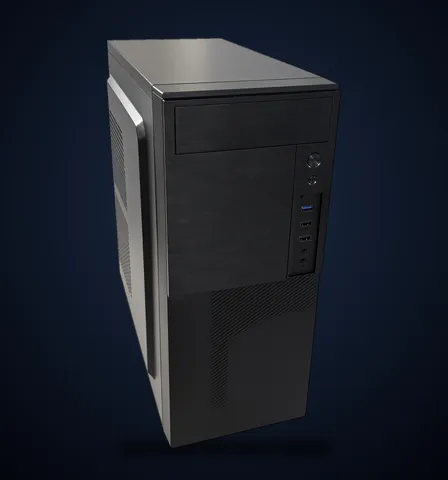
CLARYEL offers several levels of local AI computers for different needs and budgets. Current specifications, prices, configurations and purchase terms are published in the CLARYEL catalogue.
Level 1: an affordable start
€999 VAT included
For businesses and professionals who want their own local intelligence without a large initial investment. It lets you start with local models, work with documents, organise search across internal information and use the core functions of an intelligent assistant. It can be combined with affordable cloud services for tasks that need extra capabilities: a sensible way to begin without waiting for the budget for the top configuration.
For companies that need a more modern computing platform, new components, more room to grow and work by several employees. It can become the central local AI computer of the office, for internal search, document processing, intelligent agents and workflow automation. Performance can later be increased within the limits of the hardware, or you can move to a higher level.
Level 3: powerful local intelligent infrastructure
from €7,000 VAT included
For more demanding workloads: organisations that need more computing power, more serious multi-user work or specialised tasks. The configuration is chosen according to specific requirements. Systems of different levels can be used together within one architecture.
We recommend treating adoption as a sequence of stages.
Stage 1. Your own local intelligence
The company installs a local system and starts using it for core workflows. Users, access rights and document categories are defined. Your own knowledge base is created, and users get used to turning to the intelligent assistant in their daily work.
Stage 2. Connecting affordable external models
When tasks arise that need extra intelligent capabilities, suitable cloud services are connected: economical plans, available free options or programmatic connections with a controlled budget. The provider’s terms for commercial use and data processing must be taken into account. The local system remains responsible for routing requests and applying your rules on handling information.
Stage 3. Growing your own computing base
As usage grows, it becomes clear which operations are cheaper and more convenient to run locally. The company can increase system performance, add new models and extend internal automations. Accumulated documents and knowledge remain part of your own infrastructure.
Stage 4. Professional multi-model architecture
A powerful local system and several external models, each connected for suitable tasks: analysis, programming, document generation, finding alternative solutions and cross-checking results. Local intelligence becomes the central coordinator of all the work.
This is not a mandatory end point for every user. But for organisations that use artificial intelligence intensively, it can be a natural direction of development.
Why large and small companies need the same philosophy
The size of a business affects the required computing power, but not the need to control information. A small accounting firm may hold confidential data of dozens of clients. A law practice works with documents and circumstances that require special care. An engineering company keeps its own technical solutions. A trading company holds data on customers, suppliers, prices and purchases. A manufacturer accumulates production documentation and internal knowledge.
Even a small company can hold information worth far more than the computer hardware it uses. That is why your own local intelligence should not be seen only as a tool for large corporations. We believe controlled intelligent infrastructure should become accessible to businesses of all sizes.
Why CLARYEL takes this approach
At CLARYEL we do not see artificial intelligence as a separate program that the user opens a few times a day. Our goal is to make it part of the company’s daily work. That is why we offer our own local computers with prepared software and room for further development.
Core processing and work with company knowledge can take place on the customer’s hardware. When extra intelligence is needed, external models can be connected through the planned control and filtering mechanisms. The user can develop the system step by step, extend the range of tasks and connect new intelligent tools.
We do not promise absolute security, error-free models or automatic compliance with the law. Our task is to offer an architecture in which control of information, technical security and the practical usefulness of artificial intelligence are considered together.
Where to start today
You do not have to wait for the budget for the most powerful local computer. You do not have to buy many expensive cloud subscriptions. And you do not need to try to automate the whole company from the start.
Start by analysing real tasks. Which documents are used every day? Which operations take too much time? Which information should not be passed to third-party services without need? Which tasks can be done locally? When is it useful to connect more powerful external models?
Then you can choose a suitable configuration. For a small company, the entry level can be a practical starting point. A growing office may prefer a modern system with room to expand. Businesses with a high computing load may need a custom configuration. You do not need to start with maximum spending. You need to start with the right architecture.
Conclusion: your artificial intelligence should belong to your digital infrastructure
We are convinced that your own local intelligence is the strategically right foundation for companies that want to use artificial intelligence actively while keeping control of their information. Cloud models open up exceptional possibilities, and there is no need to give them up. On the contrary, they should be used sensibly, economically and within established rules for handling information.
The most promising approach is to combine both. Your own local system becomes the intelligent centre of your company. Cloud models extend its capabilities. Several independent models help explore complex questions more deeply and check decisions further. Documents, access rights and information management remain under your control.
The future belongs to multi-intelligence: local intelligence + cloud models + one managed system. CLARYEL is your own artificial intelligence that can use the capabilities of the whole intelligent world.
Start with your own AI. Expand with the world’s best.
Your data. Your infrastructure. Your choice of intelligence.
Prices, features, data retention policies and provider terms can change. Before connecting an external service, check the current terms and whether they apply to your specific use.